Mary (May) McGee contraceptive case
This is an EXTRACT from The Reconstitution of Ireland
The McGee case decision of the Supreme Court in 1973 was a landmark in Irish law. The interpretation, up to then, of a law of 1935 had made it impossible for Irish people to legally obtain contraceptives.
A 27-year-old mother of four, Mrs. Mary McGee, had taken a case in the High Court which sought a declaration that a part of the 1935 act, which banned the importation and sale of contraceptives, was invalid and contrary to the Constitution. Her case was special. She had suffered from toxaemia in each of her four pregnancies, and during the second she had had a cerebral thrombosis. Because of this her husband and herself had made up their minds not to have any more children. Mrs. McGee also thought that it would not be fair to either herself or her husband to discontinue having sexual intercourse, so they had decided on the use of contraception. This would be regarded as a most responsible attitude to adopt today, but was not so, at all, in the Ireland of 1973.
Mrs. McGee won her case on appeal to the Supreme Court. At one hearing her husband, Seamus, was asked by a lawyer if he would be happy seeing his wife using contraceptives. His answer caused a stir. He said he would prefer to have her taking contraceptives than to be in the position where he had to visit her grave very week.
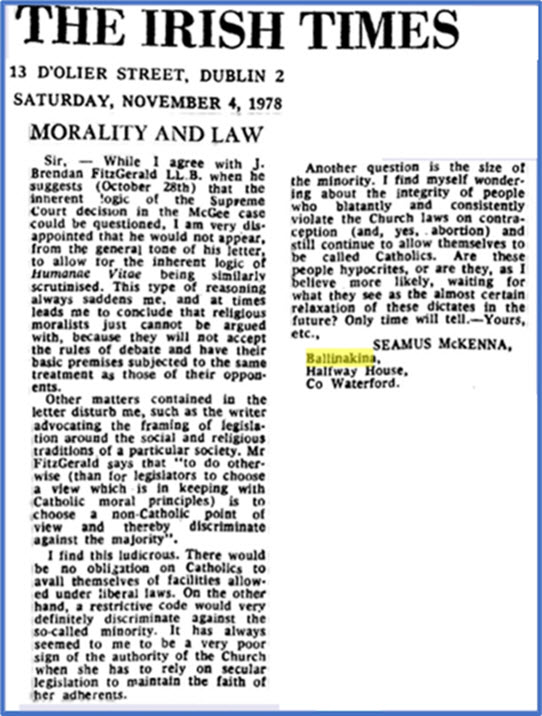
That win could not have been the end of the matter, though, because legislation was then needed to implement the court’s decision. There followed many convolutions in government and on the streets, including for a time a law that stipulated that contraception could only be provided to married couples, and then only on foot of a doctor’s prescription! Earlier, in 1968, the then Pope, Paul VI, had issued a letter to his bishops, known as an encyclical, which instructed them that what he called artificial contraception, in other words anything that relied on mechanical or chemical inhibition of conception, such as condoms or the contraceptive pill, could not be used by Roman Catholics. The title of this directive was “Humanae Vitae”. Because it came from the Pope it was regarded as the very last word on the topic for the adherents of his religion.